The team at El Centro Plumbing Pros understands the panic that sets in when a main line backs up and raw sewage threatens your floors. You need answers fast.
A quick look inside the pipes separates a minor blockage from a major collapse. We provide the most thorough sewer camera inspection El Centro has to offer to stop the guesswork.
Let’s look at exactly what this diagnostic tool shows us, the common failures hiding in local soils, and how pinpointing the damage saves you serious money.
How the inspection works
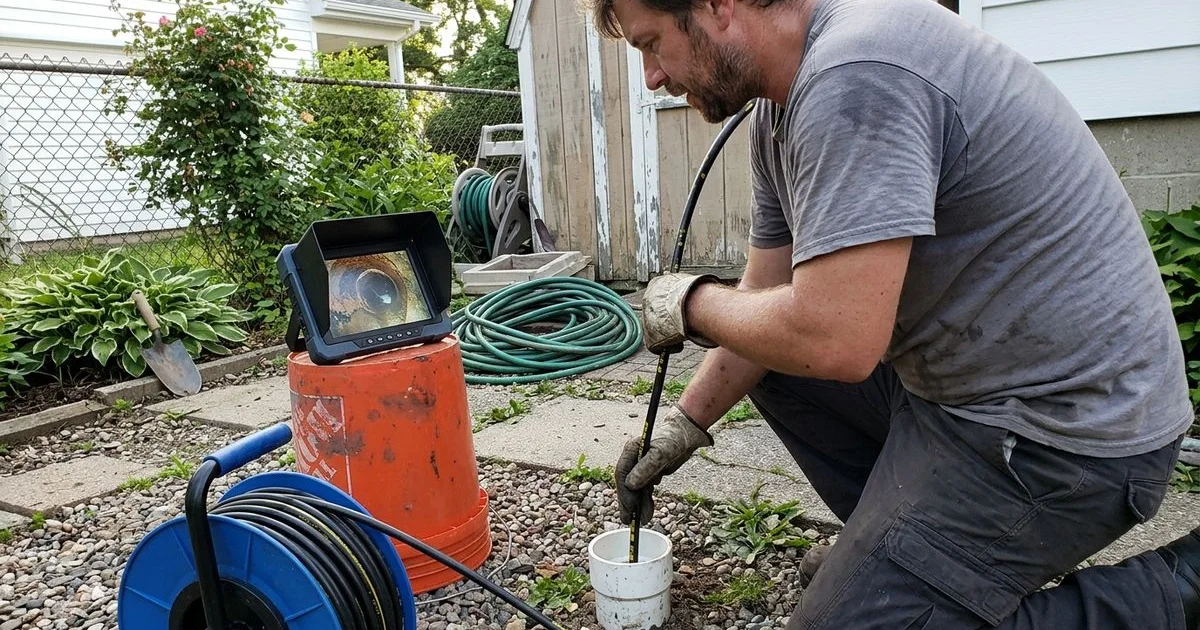
A sewer camera is a high-definition 1080p self-leveling head on a flexible push rod, complete with bright LED lights and a 512 Hz sonde transmitter built right into the system. We feed it into the line through your main cleanout and push it toward the street while the live video plays on a monitor.
You watch the screen right alongside us. This collaborative viewing matters more than it sounds. The plumber know that a verbal description of a failing pipe feels abstract, but actually seeing roots or soil through a crack in your own lateral is a totally different experience.
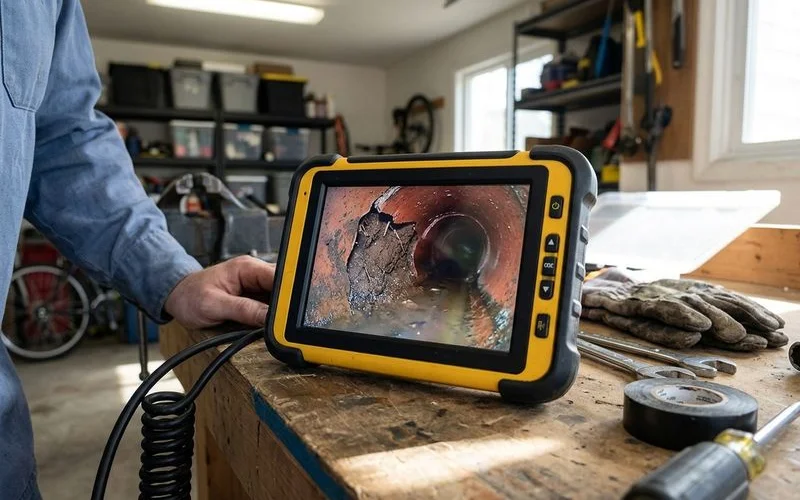
The line usually needs to be flowing first. Standing water or heavy sludge creates a blind spot. We cannot see past the obstruction during a sewer video inspection if the pipe is fully blocked.
Clearing the immediate clog is always the first step. That is exactly why drain cleaning and camera work are part of the same service here rather than two separate appointments.
Our equipment specifications ensure we catch every hidden detail:
- Resolution: 1080p HD video for clear, undeniable proof of the pipe’s exact condition.
- Lighting: High-intensity LEDs to fully illuminate pitch-black, narrow underground spaces.
- Transmitter: A 512 Hz sonde that penetrates heavy soil and cast iron for precise above-ground locating.
- Flexibility: A fiberglass push cable capable of moving smoothly through tight bends and turns.
What we find in valley laterals
Every drain camera inspection highlights how local conditions stress underground plumbing. Our inspections reveal a handful of recurring problems specific to the Imperial Valley.
Material Failures and Aging Pipes
Cracks and breaks. We often find longitudinal cracks in clay pipes, along with severe rust-through in cast iron. Both failures let water escape and allow soil to enter, which slowly undermines the pipe bedding and forces the break to grow larger.
Tuberculation and scale. Old cast iron pipes suffer from tuberculation, which is the formation of jagged rust mounds on the interior walls. The team regularly sees this rough surface catching debris, while mineral buildup narrows the effective diameter due to the region’s hard 20-grain water.
Collapse. A section of pipe can fail completely and fill with soil, meaning clearing is absolutely not an option. Excavation or structural pipe lining becomes your only path forward.
Soil Movement and Environmental Damage
Bellies. Geological surveys of the Imperial Valley show that heavy expansive clay and hard caliche soils cause frequent underground shifting. The plumber frequently find a belly, which is a sag in the line that permanently holds standing water and trapped waste.
Offset joints. Sections of pipe can shift out of perfect alignment to leave a sharp lip inside the line. We watch solids snag on this protruding lip all the time, making offsets the classic soil-movement failure in this county.
Root intrusion. Thirsty roots aggressively seek out moisture in our arid climate by entering at tiny pipe joints and growing into a dense mesh. Our cameras often reveal severe root intrusions that look exactly like a thick beard hanging in the pipe.
The valley pattern
In central El Centro and older Calexico neighborhoods, clay and cast iron laterals installed before 1970 are now well past their 50 to 75-year service life. The most common finding is not a single dramatic failure but an aging line with several small, compounding problems accumulating at once.
Sonde locating: why it saves money
Finding a hidden plumbing problem is only half of the battle. Our specialized locators turn a massive repair from exploratory digging into a highly targeted job.
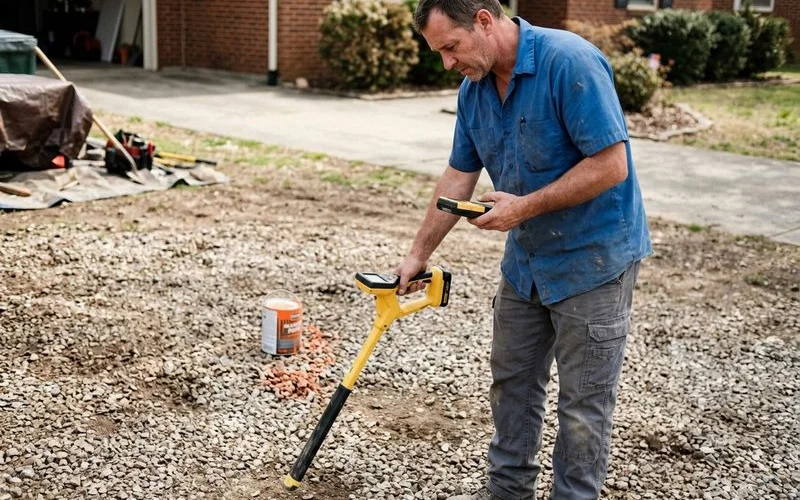
The camera head contains a specific 512 Hz frequency sonde that broadcasts a continuous magnetic signal. This low frequency is vital because locator equipment specifications prove it easily travels through up to 15 feet of thick cast iron or 25 feet of heavy clay soil without losing connection.
We slowly walk the yard with a handheld locator wand to pick up this frequency and display both the exact position and the depth of the camera. Finding the absolute strongest signal allows us to mark the precise spot with paint.
This targeted approach creates the difference between opening a small, two-foot square of your driveway and aggressively trenching across the entire front yard. Our process protects custom hardscape, mature landscaping, or a thick concrete slab from unnecessary destruction, making it the largest single cost saving in the entire job.
Current 2026 data shows how quickly blind excavation costs add up in California:
| Repair Approach | Estimated Financial Impact | Property Disruption |
|---|---|---|
| Targeted Spot Repair (Using Sonde) | Highly localized, actively avoiding unnecessary concrete or expensive landscape replacement. | Minimal footprint, usually requiring a single small access pit. |
| Traditional Full Excavation | Industry guides report averages of $80 to $250 per linear foot, frequently exceeding $15,000. | Massive destruction of driveways, lawns, and mature tree root systems. |
When it is worth doing
Certain plumbing situations demand visual proof before you make a costly decision. We recommend a full inspection whenever you face recurring issues or high-stakes property transactions.
Preventive and Real Estate Scenarios
After a second backup in a year. A single backup is an isolated event. Twice is a chronic condition, and you really need to see what is happening inside the line.
Before buying an older home. Our pre-purchase inspections during the contingency window cost a tiny fraction of a massive post-close lateral replacement in El Centro’s historic neighborhoods. A standard home inspection absolutely does not go below grade to check the pipes, so see our guide on signs of a broken sewer pipe under a slab for the specific symptoms that make this check urgent.
Before jetting an old line. High-pressure hydro jetting clears stubborn grease, but blasting water at 4,000 PSI will easily shatter a brittle, cracked clay line. We always run the camera first when a pipe’s age or history suggests structural weakness.
Emergencies and Second Opinions
After a sewage backup with any damage. A flooded floor creates a complicated mess. Our documented video footage of the exact cause is incredibly valuable for the adjuster if you are dealing with a stressful homeowner’s insurance claim.
When a repair quote seems unusually large. Full sewer line replacements in California currently average between $3,500 and $25,000 depending on depth and location. If a contractor quotes you a massive excavation, demand to see the raw video footage, and we will gladly show you the evidence just like any legitimate plumbing shop should.
What you get
Absolute clarity regarding your plumbing system is the ultimate goal. You get live viewing right on the monitor while we run the line, a digital copy of the recorded footage, and a straightforward explanation of what we found.
The team will honestly tell you if the pipe is in perfectly decent shape. You gain peace of mind and successfully avoid spending money on a major repair you never actually needed.
Stop guessing about what is happening under your foundation. We are ready to get eyes on the actual problem so you can make an informed decision.
When you need a reliable sewer camera inspection El Centro residents trust, give our El Centro plumbers a call today.