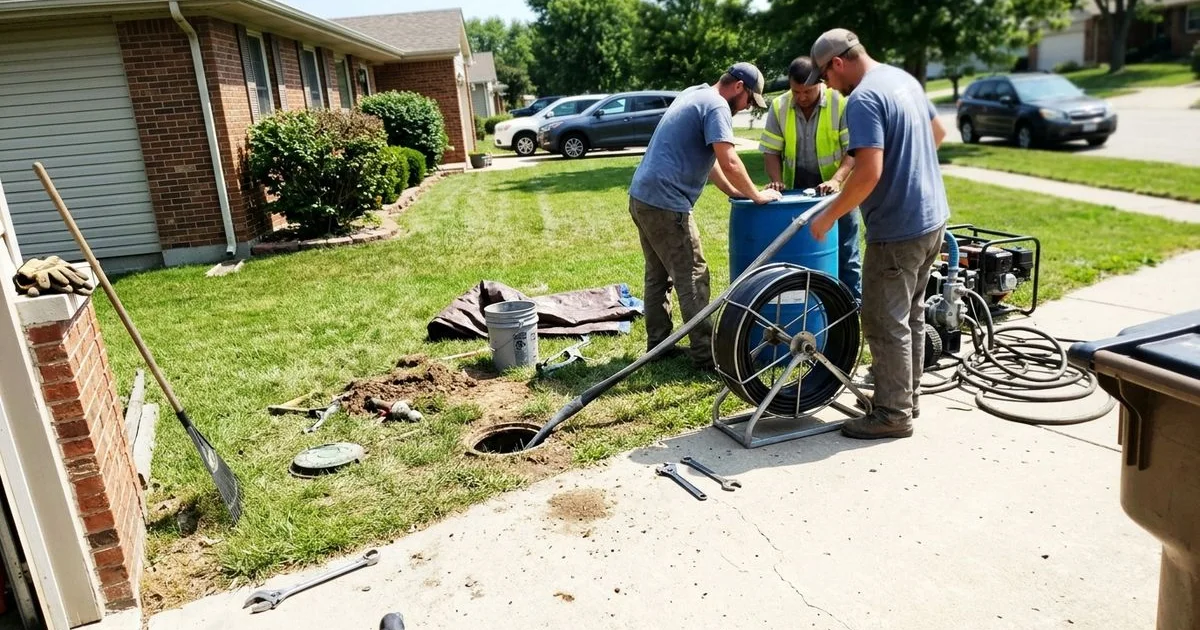
The frustration on homeowners’ faces is obvious when raw sewage backs up or sewer gas fills the house. Finding out you need a major sewer repair during an active plumbing emergency is incredibly stressful. The biggest shock is not always the broken pipe itself.
The true surprise often comes from comparing trenchless sewer repair vs dig and replace methods.
We rely on camera findings from our drain cleaning and sewer diagnosis work to drive the final recommendation. A simple root clearing cannot fix a cracked section, an offset joint, or a collapsed line.
We want you to understand exactly what you are paying for before approving an estimate. Let us break down the costs, examine the facts, and explore the exact steps to protect your property.
When this decision comes up
A failing sewer line demands immediate action when an inspection reveals structural damage. We usually reach this crossroads after basic drain clearing efforts fail to stop recurring backups, which is the pattern behind why the same drain keeps backing up. Structural failures include cracked clay sections, offset joints, severe root intrusion, bellies, or complete collapses.
Industry focus at this stage shifts from simply clearing the line to permanently repairing it. Both repair approaches discussed here will successfully produce a working sewer line. Industry experience shows the real differences lie in property disruption and total restoration expenses.
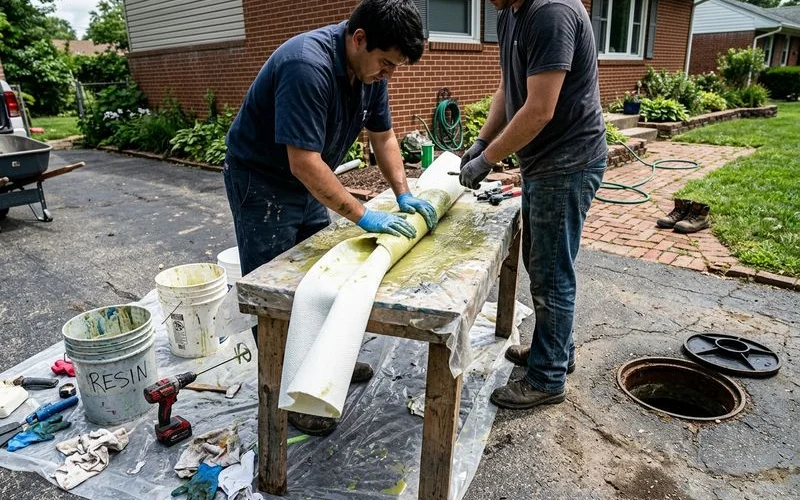
Traditional excavation requires heavy machinery, while trenchless sewer line repair requires minimal digging. We have watched local homeowners save thousands of dollars simply by avoiding concrete replacement. The initial high-definition camera inspection dictates your available options.
The plumber look for these specific signs to trigger a full repair:
- Cracked sections: Aging pipes split under soil pressure.
- Offset joints: Shifting ground pulls rigid pipe connections apart.
- Severe root intrusion: Tree roots crush weakened pipe walls.
- Sewer bellies: Sinking soil creates low spots holding standing water.
How each one works
Understanding the mechanics of each method helps clarify the price differences. We break down the exact processes below.
Trenchless CIPP lining
CIPP lining creates a brand-new, jointless pipe inside your damaged existing line. The crew accomplishes this by inserting a felt liner saturated with specialized epoxy resin. Air pressure pulls or inverts this liner into the host pipe, inflates it against the walls, and cures it using steam or UV light.
We favor this method because it typically takes only one single day to complete. You receive a continuous internal pipe that is slightly smaller in diameter but significantly smoother. Our flow tests confirm that water capacity usually remains the same or actually improves.
The process requires access through only existing cleanouts or one small, localized digging pit. Our suppliers rate these cured epoxy liners to last over 50 years, giving them the same lifespan as brand-new PVC.
Dig-and-replace
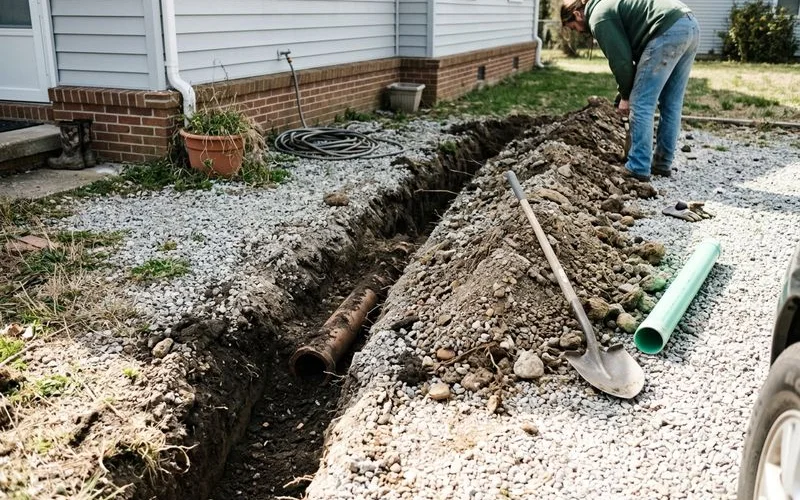
Dig-and-replace requires excavating a large trench along the entire length of the failing sewer line. Our operators remove the old pipe completely and lay down new SDR-35 PVC pipe at the correct grade. This traditional method is straightforward, permanent, and highly disruptive to your yard.
We spend several days backfilling the trench, compacting the soil, and replacing surface materials. Heavy mini-excavators will tear through grass, garden beds, and sometimes concrete driveways to reach the buried pipe. We must warn you that landscaping restoration easily adds thousands of dollars to your final bill.
Current 2026 data shows full replacements average between $3,500 and $12,000 depending on depth and length. We always provide transparent quotes so you know the full financial impact upfront.
Side by side: Trenchless sewer repair vs dig and replace
We created this direct comparison to help you evaluate the two primary methods. These numbers highlight a very important financial reality.
| Feature | Trenchless lining | Dig-and-replace |
|---|---|---|
| Yard disruption | Minimal, access points only | Full trench along the line |
| Hardscape impact | Usually untouched | Driveway or walkway cut and replaced |
| Project timeline | Often one day | Several days including restoration |
| Expected lifespan | 50+ years (epoxy resin) | 50+ years (new PVC) |
| Fixes alignment | No | Yes |
| Fixes a belly | No | Yes |
| Works on collapse | No | Yes |
| Cost per foot | $80 to $250 (average) | $50 to $250 (plus restoration) |
Our clients often find that trenchless lining boasts a lower total cost on developed lots. Excavation looks cheaper per foot on paper until you pay a contractor to repour a concrete driveway. We strongly recommend calculating the hidden landscaping costs before making a final decision.
Why valley lines fail in the first place
Local soil conditions destroy underground plumbing faster than almost any other factor. Our service area sits on highly expansive adobe clay and caliche soils across Imperial County. This dirt expands significantly when wet and shrinks during extreme 115-degree summer heat.
This seasonal cycle acts like a slow-moving hydraulic press against buried pipes year after year. Pre-1970 homes in central El Centro and Calexico commonly feature brittle clay laterals.
Our camera inspections reveal these old clay pipes have absolutely zero flexibility left. Cast iron pipes suffer a different fate, corroding from the inside out until they lose structural strength. We frequently find joints between these rigid sections pulled completely apart into jagged offsets.
Properties near irrigated agricultural land, particularly around Brawley, experience even more aggressive soil movement. Most plumbers in this market note that groundwater and soil moisture swing much harder in these farming zones.
The one question that decides it
Is the pipe still in the right shape and position, just failing at the wall? Then lining works. Has it lost its shape, alignment, or grade? Then it has to come out.
That background information dictates your safest repair choice. We know that if soil movement broke the line once, that pressure will return. A jointless epoxy liner flexes and tolerates future minor ground movement far better than rigid clay.
The team considers this flexibility a massive advantage in Imperial County. A rigid clay pipe snaps, while a cured-in-place pipe holds strong. We must caution you, however, that lining cannot magically realign a pipe that the earth has already pulled completely out of position.
Where each one wins
The right choice depends entirely on your property layout and pipe condition. We evaluate several specific factors before finalizing a repair plan.
When Trenchless Makes Sense
CIPP lining provides the highest value under these specific conditions:
- The line runs under a concrete driveway, a patio, a walkway, or expensive mature landscaping.
- The host pipe is cracked or root-infiltrated but remains structurally intact and correctly aligned.
- The property lacks access for heavy excavation machinery.
- You require the system to be fully operational within 24 hours.
When Excavation Makes Sense
We must default to traditional trenching for severe structural failures. Dig-and-replace becomes mandatory in these situations:
- The line is completely collapsed, crushed, or badly offset.
- A severe belly exists that requires physical grade correction.
- The failing run is very short and sits under easily accessible open dirt.
- The old pipe material is deteriorated end-to-end.
The Hybrid Approach
The plumber sometimes recommend combining both methods for maximum efficiency. You can excavate and replace one heavily failed segment, then line the rest of a marginal run. We find this combination offers the best value on older laterals with only one severe bad spot.
What to ask before you approve either one
Always demand visual proof and a detailed cost breakdown before signing any contract. We encourage every homeowner to ask tough questions to avoid hidden charges.
Bring this exact checklist to your next contractor meeting:
- Camera footage: Request the full video file showing the exact damaged section.
- Method justification: Ask why one method was chosen and the other ruled out.
- Restoration costs: Verify if concrete pouring, sod, and irrigation repair are included.
- Warranty details: Demand at least a 10 to 50-year guarantee on epoxy liners.
- Remaining line health: Ask what happens to the older sections not being replaced.
The plumber will gladly explain every detail so you understand the long-term plan. Repairing only eight feet of a forty-foot lateral that is uniformly deteriorating solves this year’s problem but guarantees another disaster next year.
Our comprehensive leak detection and slab leak repair page covers similar supply-side issues if your inspection uncovered inward water leaks. Securing a permanent fix ensures your plumbing operates flawlessly through every season.
We invite you to contact our Imperial County plumbers today to schedule your high-definition camera inspection and get a transparent, data-driven estimate.
Before choosing between trenchless sewer repair vs dig and replace, take your time, examine the data, and select the solution that protects your home for decades.