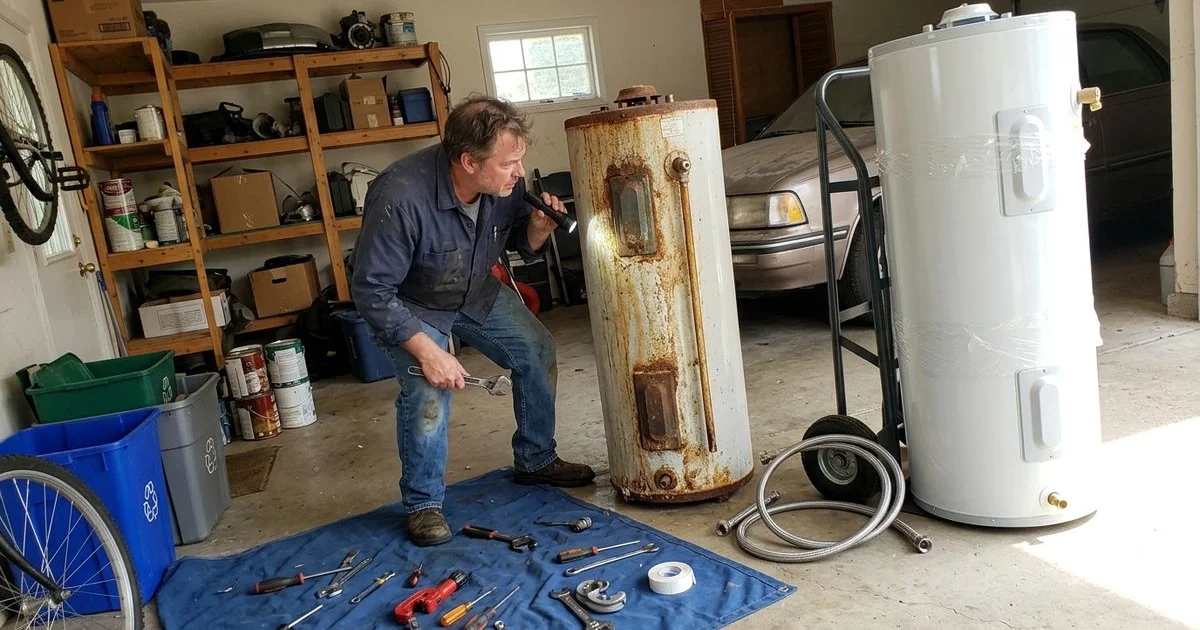
Making the right call on water heater repair vs replacement in El Centro does not have to be a guessing game.
You wake up to a cold shower or find a garage floor covered in water. That panic sets in fast. This exact scenario comes up every week across the Imperial Valley. El Centro Plumbing Pros exists to solve one problem, which is getting you connected to a reliable plumber quickly, at any hour, and in your preferred language.
Understanding the difference between a simple fix and a dead tank saves you thousands of dollars. Let’s look at the hard data, what your symptoms are actually telling you, and explore the most practical ways to respond.
The short decision rule
The plumber use a straightforward guideline when evaluating your equipment. Replacing the unit is mandatory if the tank itself is leaking or rusting. Repairing makes sense if a simple part fails on a sound system.
We find that almost every real-world emergency fits into one of those two categories. The rest of this guide helps you weigh borderline cases. This prevents you from paying for a quick fix that only buys you another six months of hot water.
Symptoms that point to replacement
We look for several critical red flags that mean a tank is permanently dead. A leaking steel body, hot-water rust, and heavy scale buildup past the factory warranty mean the unit must be replaced. Here is a breakdown of those fatal symptoms:
- A leaking tank. This problem is not repairable. Steel that has corroded through in one place has thinned everywhere. Minor drips turn into massive floods quickly. FEMA reports that just one inch of standing water inside a home can cause up to $25,000 in property damage. A patch job simply will not hold.
- Rust in the hot water only. Internal corrosion is occurring. Your anode rod is likely gone, and the tank itself is oxidizing from the inside.
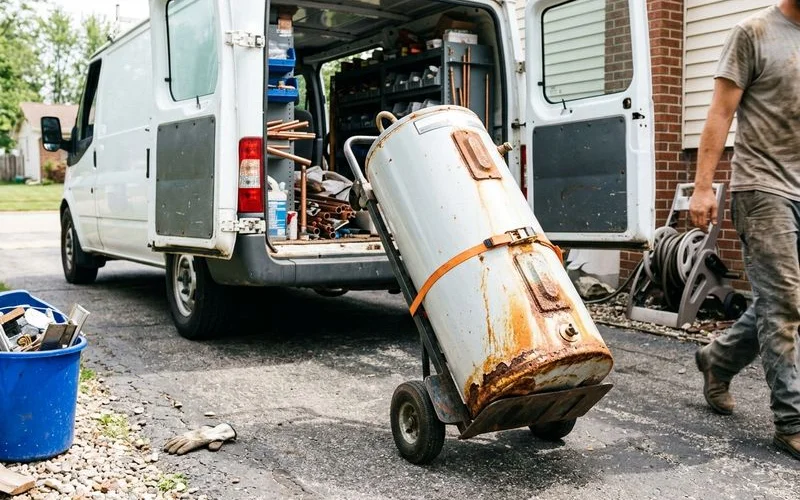
- Past rated life with heavy scale. These two factors together are worse than either one alone. Imperial Valley municipal water hardness runs 340 to 350 parts per million (ppm), nearly double the “very hard” threshold. We know that thick scale forces the tank bottom to run extremely hot for years. The combination of age and baked-on sediment eventually cracks the glass lining.
- Repeated repairs. Two service calls in a single year on the same unit is a bad financial move. The tank is clearly failing. The plumber advise against putting good money into dying equipment. It is simply a mistake.
- A drain valve solid with mineral. The unit cannot be maintained if it will not drain. This confirms years of neglect.
Symptoms that point to repair
We can often save a younger unit if the structural integrity remains solid. Component failures like a bad thermostat, a broken dip tube, or a worn thermocouple cause total shutdowns but require only minor repairs. Here are the issues that usually make sense to fix:
- No hot water, no leak. This usually points to a failing thermocouple, gas control, or pilot assembly on gas units. Electric models might have a bad high-limit switch, element, or thermostat. We replace thermocouples regularly for about $150 to $250. Compare that repair bill to the $1,200 to $2,500 average cost of a full 2026 system replacement. All of these are replaceable components, not the tank itself.
- Water too hot or too cold. This indicates a simple thermostat malfunction. A local technician can swap this part out in under an hour.
- Not enough hot water on a younger tank. A broken dip tube often sends cold water straight to the outlet. This creates a cheap fix that perfectly mimics a dying heater.
- A dripping T&P valve. The problem stems from either a faulty valve or high system pressure. Both issues are addressable. We strongly recommend fixing this immediately. Ignoring the temperature and pressure valve puts your home at risk, as it is a critical safety device.
- Popping with no other symptoms. Flushing the sediment out usually resolves the noise. The noise usually stops completely after a deep clean. The plumber will check the anode rod and reassess the performance. On a young tank, a heavy flush often cures it completely. This simple maintenance step extends the system lifespan.
The cost math
Our financial logic for deciding to repair or replace water heater units centers around the 50 percent rule. You should replace the unit when a repair bill hits half the cost of a new installation, adjusting for local water conditions.
The standard industry benchmark suggests that when a repair approaches half the cost of replacement, replacement wins. That provides a reasonable starting point.
We always apply two crucial local adjustments to this calculation.
- Adjustment one: remaining life. A repair on a tank with years left is an investment. The same repair on a tank near the end of its life is just a deposit on a replacement you are going to make anyway.
- Adjustment two: hard water. In our 20-grain local water, the remaining life is shorter than the factory rating suggests. Factory ratings assume perfect municipal water conditions. We factor in maintenance history closely. Assume less time than the number on the label unless the unit has been flushed regularly. Routine descaling is the only way to reach that benchmark.
Planned beats emergency
A planned replacement happens on a weekday with the exact unit you chose. An emergency replacement happens after 50 gallons have found your garage floor, at whatever hour that is, with whatever is available. When a tank is clearly near the end, choosing the timing is worth serious money.
What we look at on the water heater repair vs replacement visit
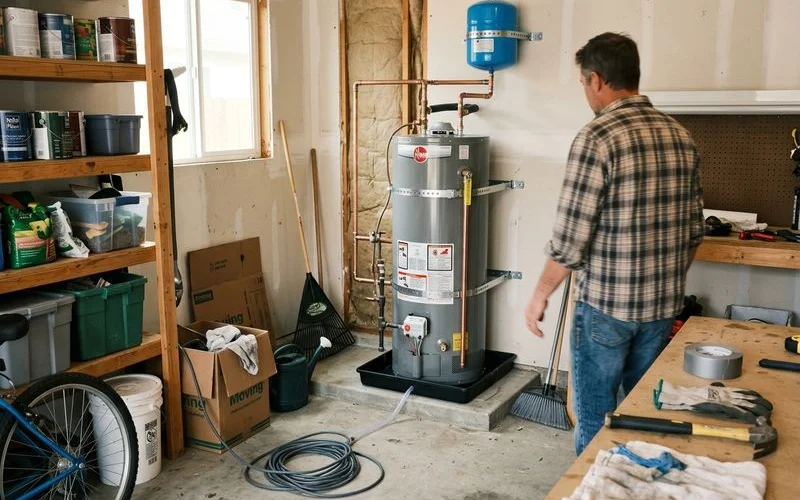
We inspect several structural and safety elements the moment we arrive. A professional plumber checks the data plate age, sediment levels, safety valves, and the anode rod condition to determine the remaining lifespan. Here is exactly what gets checked during a service call:
- Age and Sediment: Pulling the age directly from the data plate is step one. A quick flush tells the technician whether the tank produces clear water or heavy sediment.
- Corrosion Levels: The anode rod condition reveals exactly how much protection the steel has had. Early signs of corrosion at the fittings and the bottom seam require immediate attention.
- Code Compliance: California Health and Safety Code Section 19211 requires specific earthquake bracing. Seismic straps and thermal expansion tanks must meet current local building codes.
- Air and Exhaust: Venting and combustion air pathways must be clear on all gas units to prevent carbon monoxide risks. Poor airflow causes major efficiency drops.
- Original Install Quality: A surprising number of problems trace back to sloppy initial workmanship. We inspect the piping and connections to see if the original installer cut corners. Sloppy initial workmanship is a common culprit.
Then you get the actual condition and both options presented with real numbers. A professional never hands you a recommendation without solid reasoning behind it. That is how every water heater repair and replacement call runs.
If you are replacing
We guide homeowners through two critical decisions when a new installation is inevitable. You must choose between a standard tank or a tankless system, and decide whether to add a water softening unit to protect your new investment. Deciding these details upfront prevents premature failures down the road.
System Type
Choosing between a standard tank or a tankless unit is a real financial question here. Our tank vs tankless guide covers the tradeoff honestly.
Hard water weighs heavily on this answer. Premium tankless models from brands like Navien or Rinnai offer endless hot showers. Mandatory annual chemical descaling is required to keep those warranties valid.
Water Treatment
Putting a new tank on untreated 20-grain water restarts the exact clock that killed the old one. Pristine new systems get destroyed by mineral buildup within a few short years. If the previous failure was scale-driven, softening the water is mandatory.
A modern whole-home water softening system typically costs between $1,500 and $3,000 to install in 2026. We consider proper treatment the difference between your new unit reaching its rated life and repeating history. Making a decision about water heater replacement cost factors and logistics does not have to be stressful.
Call our El Centro plumbers today to schedule a fast, transparent inspection. We are ready to restore your hot water.