Many local plumbing disasters start as minor hard water faucet problems. A dripping tap might seem like a small nuisance, but it is actually a clear warning about the water chemistry flowing through your entire home. The same heavy mineral load destroying your sink fixtures is quietly cementing the inside of your water heater.
Industry experience shows that ignoring these early signs often leads to catastrophic bursts and sudden losses of hot water. Let’s look at the data to understand what actually fails inside these fixtures. Then, we will explore a few practical ways to respond before a larger emergency strikes.
What is actually wearing out
Industry experience shows that the cartridge, the valve seat, or the aerator are the exact parts failing when a faucet stops sealing. Mineral deposits from hard water physically grind away at these precise internal components until they break. Open up a broken fixture and you will usually find one of the following issues.
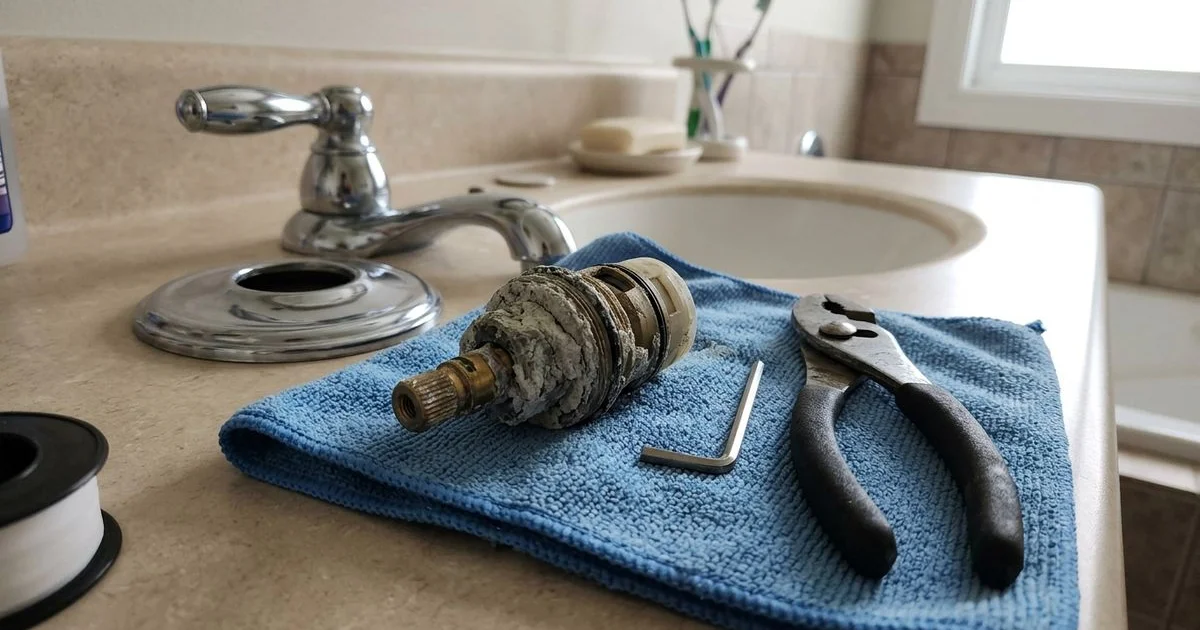
The cartridge. Most plumbers in this market see these precision parts fail constantly because modern faucets rely on a ceramic disc cartridge like the popular Moen 1222 or Delta Diamond Seal models. These mechanisms feature two polished ceramic discs that must rotate flawlessly against each other. When the discs align perfectly, the water flows freely.
Plumbers in this market pull out cartridges every week that look completely ruined. Shutting the flow off depends entirely on both surfaces staying perfectly smooth. Mineral deposits wedge themselves directly between those polished discs.
Our local water quickly scores those discs until the seal degrades completely. Now every time you turn the handle, you grind a fine abrasive across a precision sealing surface. The faucet then starts dripping constantly or becomes incredibly difficult to turn.
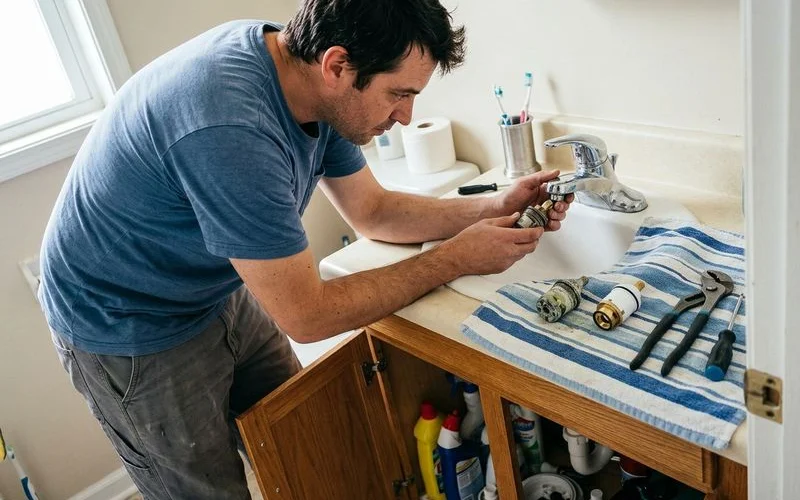
The valve seat. Our emergency calls often involve older compression-style faucets where a soft rubber washer must press tightly against a solid brass seat. Hard mineral crust on the seat means the rubber washer no longer meets a perfectly flat surface. The fixture will not fully close no matter how hard you tighten the handle.
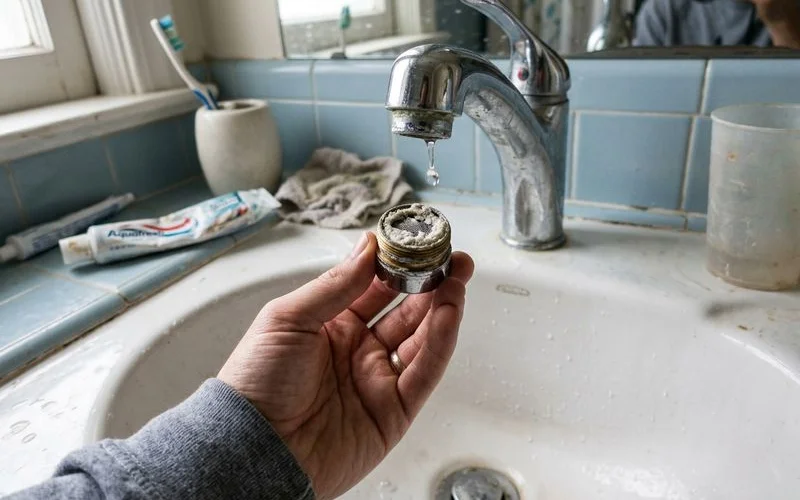
The aerator. The plumber frequently handle calls for weak flow caused by the small metal screen located at the tip of the spout. This aerator catches mineral flakes and builds its own thick scale over time. The stream sprays violently sideways, and many people assume the whole faucet is failing.
The quickest fix usually takes just two minutes to clean or replace that clogged screen.
Why it happens faster in El Centro
Our local water runs at roughly 340 to 350 mg/L of total hardness, which equals about 20 grains per gallon. This massive mineral load is nearly double the national threshold for very hard water, destroying fixtures much faster than normal. The United States Geological Survey defines “very hard” water as anything over 180 mg/L.
Our El Centro customers are fighting a daily battle against calcium and magnesium levels that simply overwhelm standard plumbing hardware. Manufacturer service expectations and warranty periods are written for average water conditions. A cartridge rated for ten years of normal use is not being used normally in the Imperial Valley.
Our testing shows it is constantly exposed to twice the abrasive mineral load its original designers assumed. Heat makes this chemical reaction significantly worse on the hot water side. This thermal acceleration explains why hot water handles usually fail first and why failing angle stops often lead to sudden burst pipe emergencies.
Our long summers with warm supply water mean this heavy mineral deposition runs at full speed all year round.
It is not a bad faucet
If you are on your second or third cartridge in a good-quality fixture, nothing is wrong with the brand itself. The water is doing exactly what 20-grain water does to mechanical parts. Keep this fact in mind before you spend money replacing a unit that only needs a basic rebuild.
Repair or replace
Our standard advice is to rebuild the faucet if the body is in good shape, but replace it if the exterior finish is corroded. Diagnosing the exact condition of the fixture dictates the most cost-effective path forward.
Rebuild when the faucet body and finish still look great, replacement parts are readily available, and the main problem is just a dripping spout or a stiff handle. A new ceramic cartridge and seat kit costs a small fraction of a brand-new fixture. Our industry data from 2026 shows a complete professional replacement averages $262, while a cartridge costs under $40.
Replace when the metal body is corroded or cracked, the chrome finish is pitting and flaking off, or the model is fully discontinued. You should also upgrade if the exact same faucet has already been rebuilt multiple times. The team recommends a full replacement in these cases because sinking more money into a deteriorating shell is a bad investment.
Selling a brand-new faucet simply because it is quicker than diagnosing a faulty cartridge is not genuine customer service. The best approach saves the customer money by preserving high-quality brass bodies. Our fixture repair and replacement work focuses heavily on fixing the specific failed component whenever possible.
Older El Centro homes feature shutoff valves that seize completely from these exact same mineral deposits. A frozen shutoff valve that will not close during a burst pipe scenario is a massive emergency waiting to happen. The same scale is what drives up the cost of fixing a running toilet, since the flapper and fill valve sit in the same mineral-heavy water. Replacing these angle stops underneath the sink is required either way to ensure your home remains safe.
Many homeowners ask for the hard numbers when making this decision. The data clearly shows why a basic repair usually makes the most financial sense. Our compiled pricing guide offers a realistic look at typical 2026 plumbing expenses.
| Service Option | Average Material Cost | Typical Outcome |
|---|---|---|
| DIY Cartridge Rebuild | $15 to $45 | Restores factory seal and handle movement. |
| Pro Faucet Repair | $88 to $173 | Fixes drips securely without removing the whole unit. |
| Full Pro Replacement | $262 to $360+ | Provides a completely new fixture and fresh supply lines. |
What actually slows it down
The most effective strategy for slowing faucet cartridge wear is to clean your aerators regularly and install a whole-home water softening system. Removing the physical minerals from the water supply is the only permanent way to stop the relentless damage to your plumbing.
Clean aerators regularly. Unscrew the small tip, soak it in white vinegar for ten minutes, rinse it thoroughly, and reinstall it every few months. This process removes the calcium flakes that restrict your water pressure. Our service calls prove this is the highest-value five minutes of preventative plumbing maintenance available in the entire Imperial Valley.
Wipe fixtures dry. Water drops left to evaporate on chrome or brushed nickel will leave the hard minerals behind. This creates crusty white rings around the base of your sink handles. Our design specialists know this is mostly a cosmetic issue, but it represents the highly visible half of the hard water problem.
Do not force a stiff handle. A tight or squeaky handle means the internal cartridge is already scaling up. Forcing the metal accelerates the severe internal scoring and ruins the ceramic discs. Our emergency dispatchers hear about snapped handles all the time, so have a professional rebuild it instead.
Treat the water. A properly sized softening system is the single real answer to this regional crisis. A good system physically removes the abrasive hardness before it ever reaches any fixture. Our water softeners page covers the exact sizing requirements needed to handle high valley hardness levels.
Your cartridges, valve seats, and aerators will then wear down at their much slower, factory-designed rate. Soft water protects your entire plumbing infrastructure simultaneously.
Our final warning to homeowners is that faucets are just the smallest things that hard water destroys. They serve as a highly visible, early indicator of a much larger threat lurking in your garage or utility closet.
If your sink fixtures are failing early, your water heater is quietly experiencing that exact same abrasive buildup on a much larger scale. Our local data aligns with the Insurance Institute for Business & Home Safety, which notes that 69% of water heater failures involve a slow leak or sudden burst.
The national average cost for that resulting water damage is over $4,444 per claim.
Addressing hard water faucet damage today is the best way to prevent a major property loss tomorrow. Give our El Centro plumbers a call to inspect your fixtures and evaluate your water quality before a minor drip turns into a midnight emergency.